Springfield Lakes, QLD · Greater Brisbane | Daniel@reyn.com.au | Australian citizen
Software & Intelligent Systems
My practical engineering career began in 2001. I apply that experience to software, sensing and control for physical systems.
The work below separates verified results from future development and shows how mechanical behaviour, code, measurement and testing were brought together.
Relevant foundation
Bachelor of Engineering (Honours), majoring in Mechatronic & Robotic Engineering, with First Class Honours; final GPA 6.36/7.0. High Distinctions include Mechanical and Mechatronic System Design, the AUV research project, Robotics and Machine Vision, and Pattern Recognition and Machine Learning.
Smart Ramp — from an FEA brief to a searchable model and physical test platform
01 · SMART RAMP
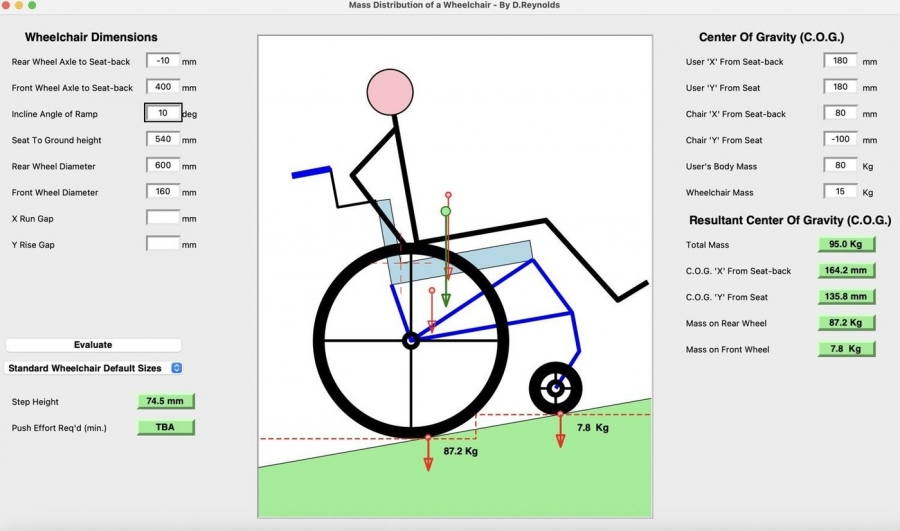
The important question was not simply whether one ramp geometry worked. Passage depended on gap, rise, wheel diameter, mass distribution, centre of gravity and contact state. I proposed a parameterised rigid-body approach, built the Python analysis and interactive tool, then developed the physical apparatus used to investigate the behaviour.
Derived wheel-edge contact geometry and the force chain from first principles in a 249-formula spreadsheet
Implemented two interactive Python applications, including a 717-line centre-of-gravity and wheel-load model
Converted the derivation into repeatable parameter sweeps and reported invalid physical states rather than only a favourable answer
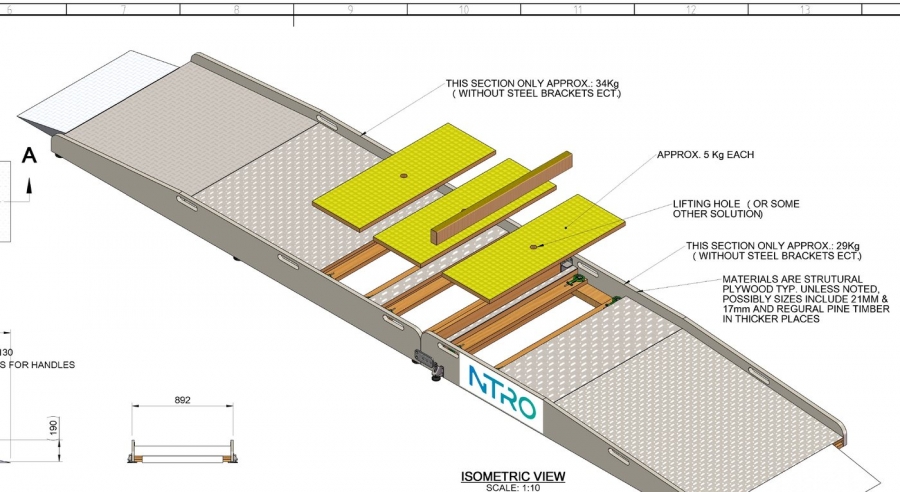
Designed a four-metre modular platform with adjustable gap and ten load-cell modules
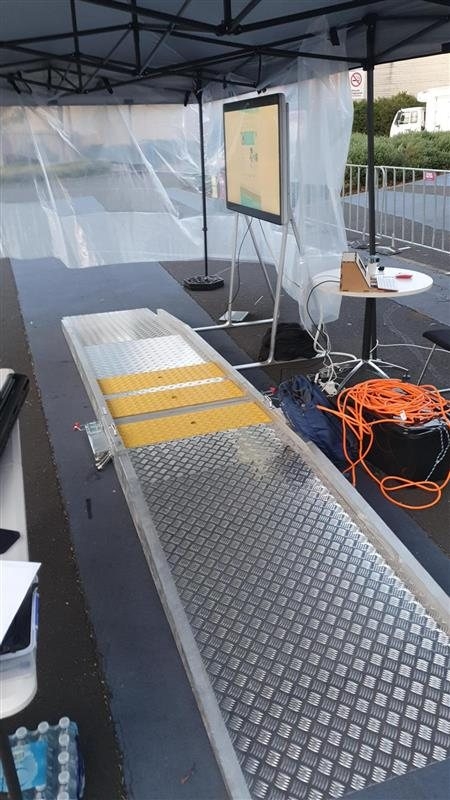
Integrated Raspberry Pi acquisition, calibration and public demonstration hardware
PythonPhysical modellingInstrumentationValidation
Interactive analysis made geometry, centre of gravity and wheel reactions visible.My engineering drawing: modular load-bearing regions and adjustable gap.The completed apparatus in use at a public demonstration with wheelchair participants.
My contributionProposed the computational direction, derived the model and delivered the Python toolchain.
Physical evidenceDesigned and built the four-metre apparatus, load-cell modules and acquisition system.
Decision valueTurned one geometry into a searchable operating envelope with invalid states identified explicitly.
Evidence boundary: the apparatus demonstrated sensing and contact behaviour. It was not used to claim a quantified model-versus-measurement accuracy that the retained evidence cannot support.
Mechatronic architecture and embedded continuation
Autonomous underwater vehicle — mechanical, electrical and control interfaces in one system
02 · AUV
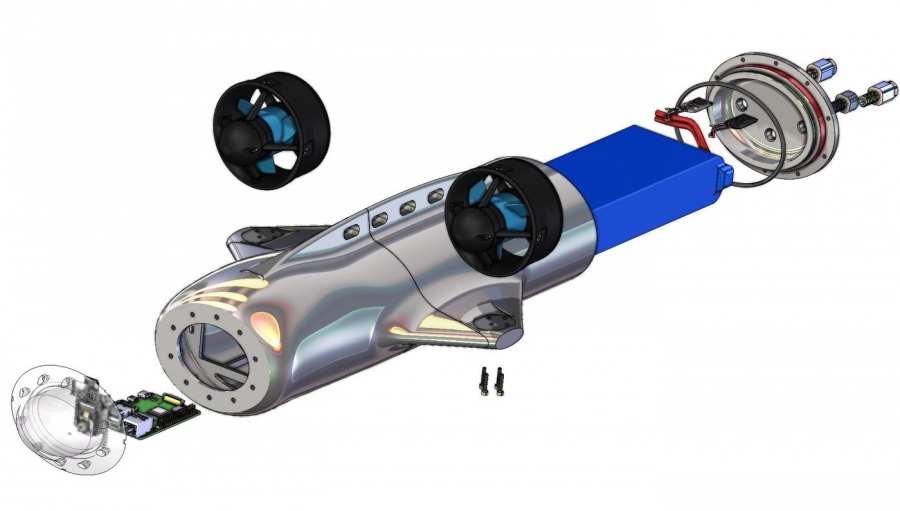
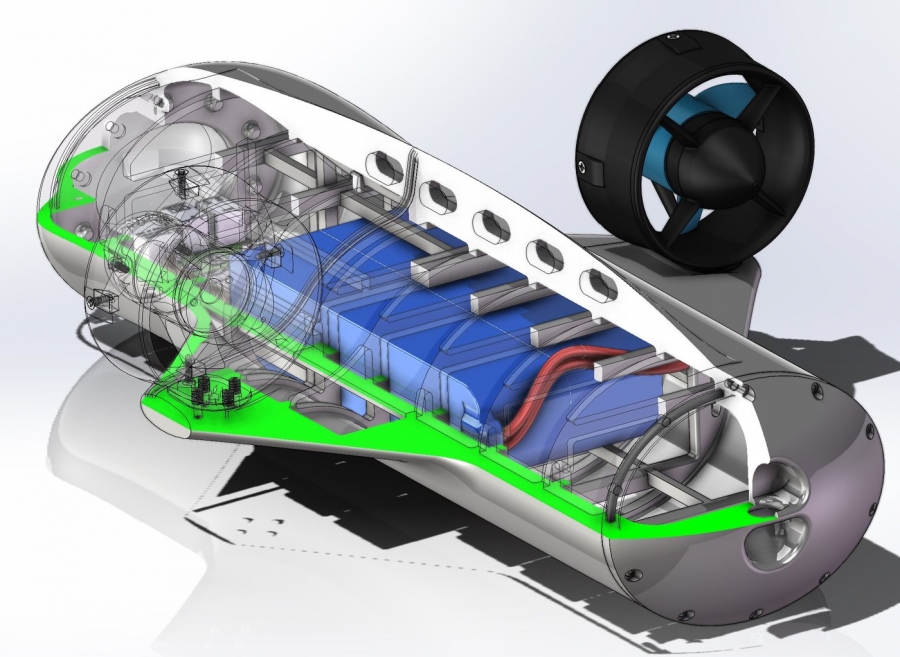
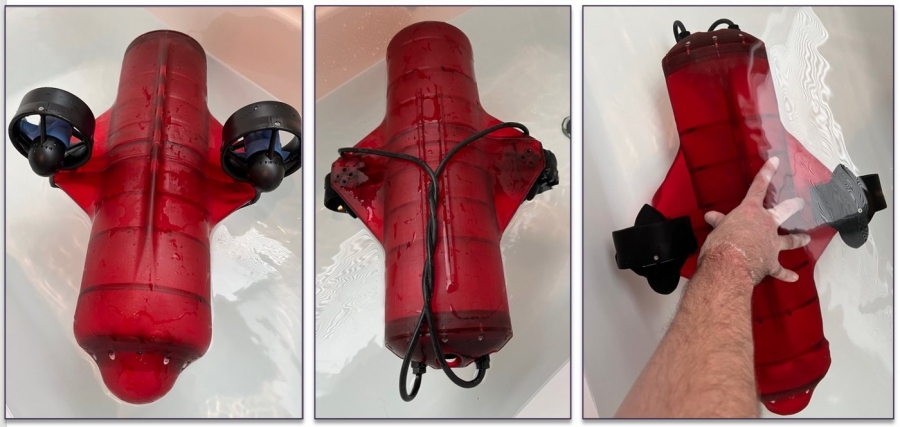
Hull, thrusters, electronics and battery packaging.Batteries, internal structure, cable routing and the O-ring sealing interface.Pressure-hull leak and wet-system testing. Powered command and propulsion evidence was captured separately on video.
The year-long assessed project combined pressure-hull architecture, structural analysis, buoyancy, trim, propulsion, power and physical verification. I continued it independently as an embedded platform using STM32-family C.
Register-level clock, UART and timer configuration
Dual PWM generation, ESC arming and safe command limits
Differential-thrust mixing and immediate neutral/disarm path
Leak-interrupt fault handling, staged wet testing and powered trials with two T200 thrusters
PID, IMU and pressure-sensor interfaces remain development evidence rather than claimed fully validated autonomy.
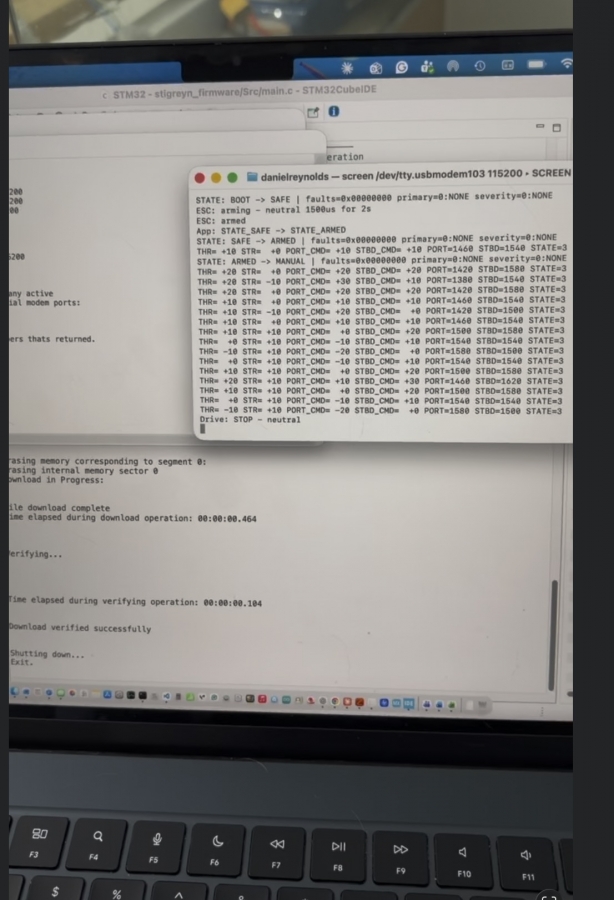
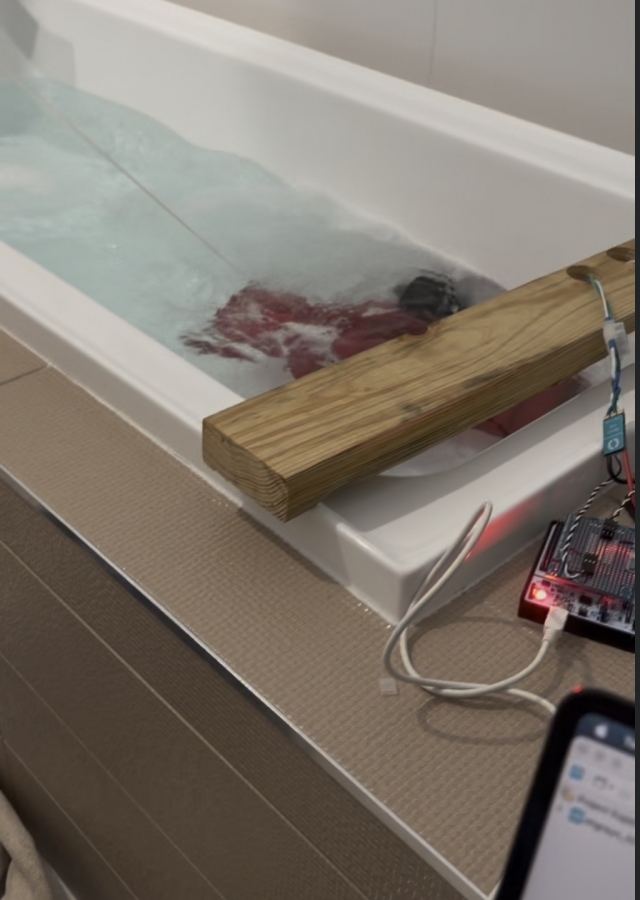
Running STM32 firmware: the serial trace records boot, safe and armed states, throttle and steering commands, and the resulting port and starboard outputs. Select to inspect the full frame.Frame from the powered wet-test sequence. The complete clip shows motion and state changes more faithfully than a still image.
Evidence shown: the terminal frame records the running control states and mixed outputs; the original video below shows the corresponding physical response.
Controlled powered test
Enough thrust to prove the control path — deliberately not a full-power run
The two thrusters provide substantially more thrust than could be used sensibly in a domestic bathtub. I increased output only far enough to confirm arming, command response, direction and sustained powered operation while the vehicle remained tethered.
Direction is produced by mixing throttle and steering commands into separate port and starboard outputs. A meaningful manoeuvring assessment belongs to the next stage: free-swimming trials after the buoyancy and trim arrangement is finalised.
Why the test arrangement looks unfinished: the rear cover was deliberately left off so the hull could flood rather than retain the full buoyancy of a sealed pressure body. The controller, power distribution and monitoring electronics therefore remained outside the vehicle, where behaviour and faults could be observed and isolated during propulsion testing.
Assessed systemYear-long multidisciplinary project awarded a High Distinction.
Continued independentlyRegister-level STM32 C, safety states, UART command and differential-thrust control.
Physically testedDual PWM, command-state changes and two T200 thrusters demonstrated in staged wet trials; video evidence is available.
Computer vision and physical coordinates
Tracking identical vehicles in a moving-camera arena
03 · COMPUTER VISION
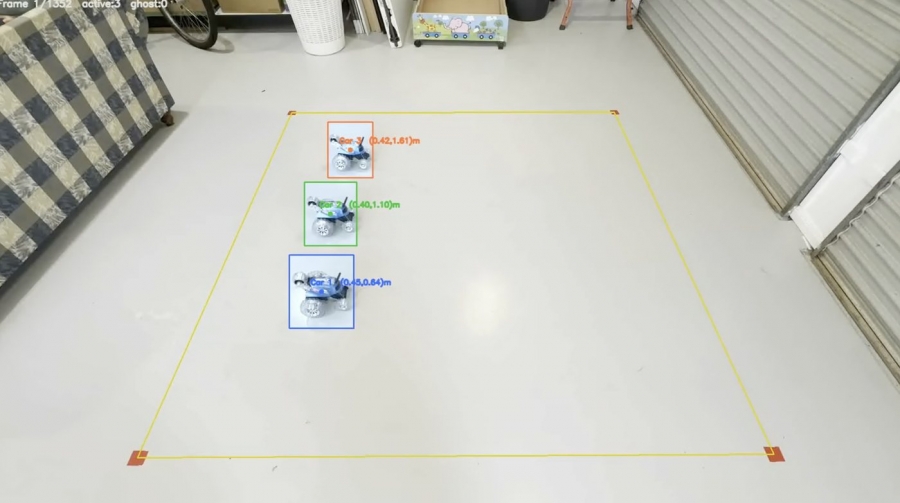
Persistent identities and metric arena coordinates while the handheld camera moves.
I calibrated the ultra-wide camera, tracked four arena markers and recomputed a projective homography so detections could be expressed in arena coordinates rather than image pixels. The supplied YOLO detector was only one component; my work surrounded it with calibration, identity management, coordinate mapping, timing and output validation.
0.4315 pxCamera-calibration reprojection error
91.61 to 0.55 msPreprocessing reduced by precomputing the undistortion remap
1,352Frames with matching coordinate-output lines
6.93 msMean tracking-loop time; about 144 fps equivalent
>99%Four-corner arena tracking across the sequence
Kalman-assisted association, ghost states and boundary-aware reacquisition helped preserve the identities of three visually identical vehicles through exit, loss and overlap.
OpenCVHomographyTrackingCoordinate systems
Boundary: YOLO weights were supplied. The demonstrated work is the perception pipeline, calibration, tracking, identity logic, world-coordinate mapping and evaluation around that detector.
Supporting closed-loop visual control
From image error to physical actuation
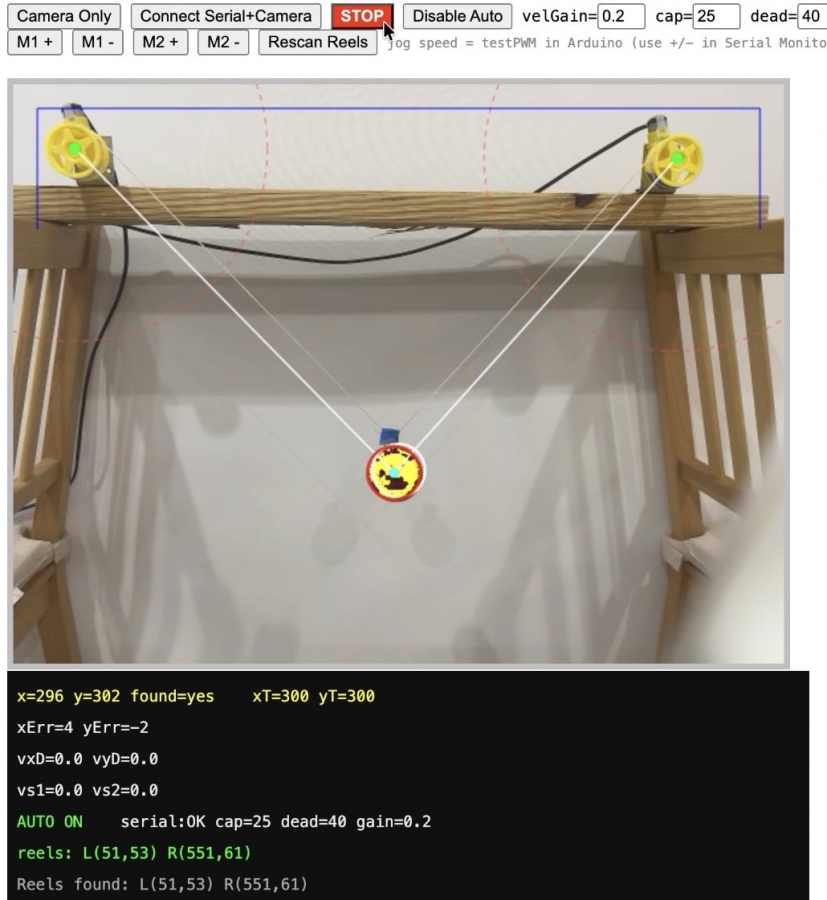
Browser vision, click-selected target and live control state.
A physical rig used browser-based vision to locate a suspended ball, calculate image-plane error and send serial commands to an Arduino Nano driving two PWM motors. The prototype moved the ball toward a user-selected target without encoders.
Boundary: prototype evidence, not production motion control.
Applied machine learning
Held-out evaluation before a favourable headline number
04 · MACHINE LEARNING
EEG-derived prediction
Six engineered features were used to predict an established depth-of-anaesthesia reference. Eight recordings supported model selection through five-fold cross-validation; four separate recordings remained held out for final evaluation.
0.771Mean held-out Pearson r for k-NN
0.706Mean held-out Pearson r for Random Forest
Random Forest produced the strongest single result, but k-NN was more consistent across the four unseen cases. The engineering lesson was about generalisation and case-to-case variation, not choosing the largest isolated number.
Feature engineering for image clustering
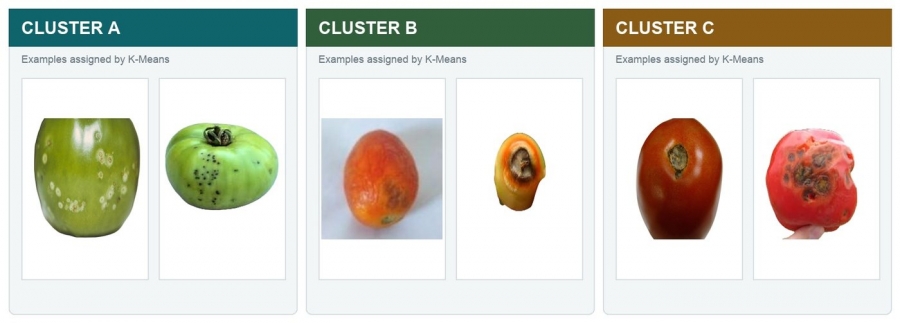
Representative model assignments after foreground masking and feature engineering; not manually labelled quality classes.
Removing background influence and using physically meaningful colour features improved cluster separation more than adding model complexity.
Evaluation boundary: an exploratory post-hoc result of r = 0.823 used the same dataset for selection and scoring, so it is not presented here as held-out performance. This is technical pattern-recognition evidence, not a clinical claim.
Sensing to spatial reconstruction
3D scanner — a complete electromechanical and software chain
05 · 3D SCANNING
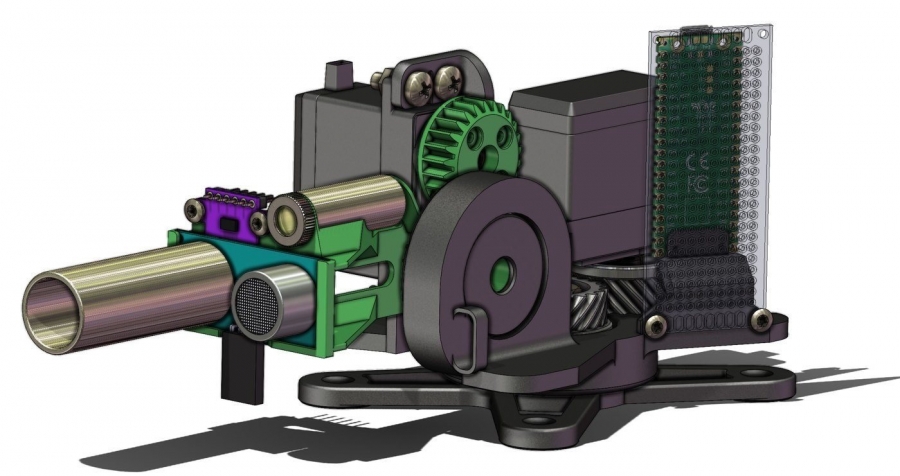
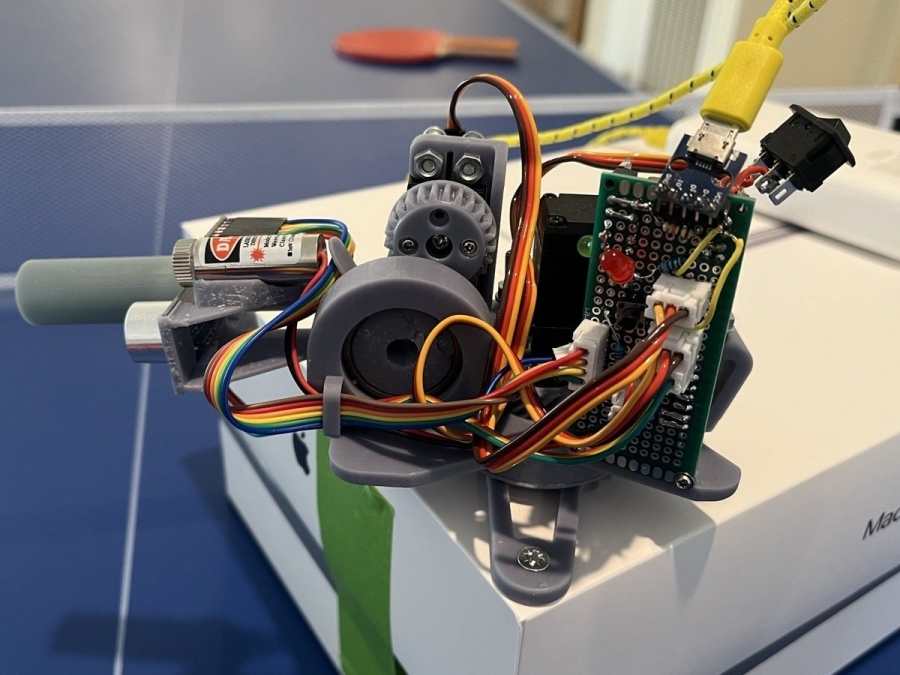
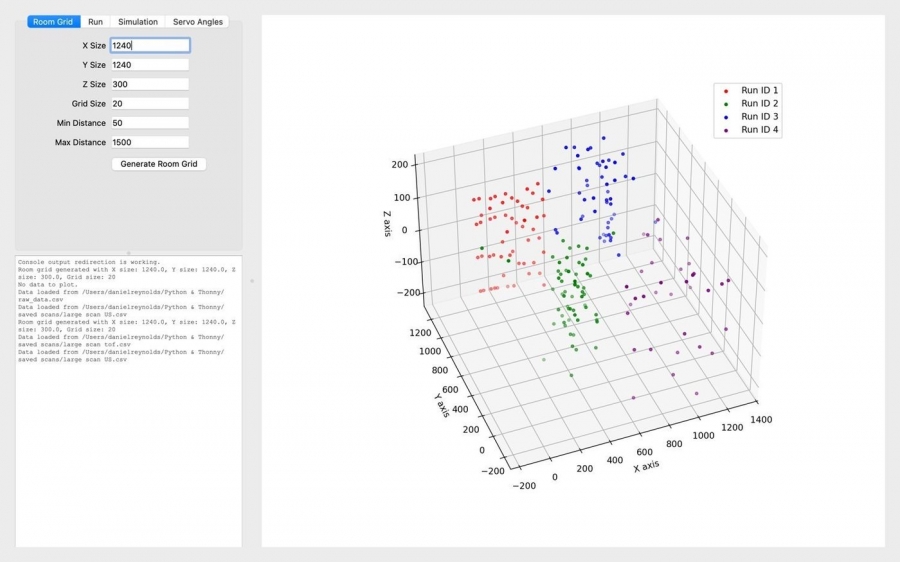
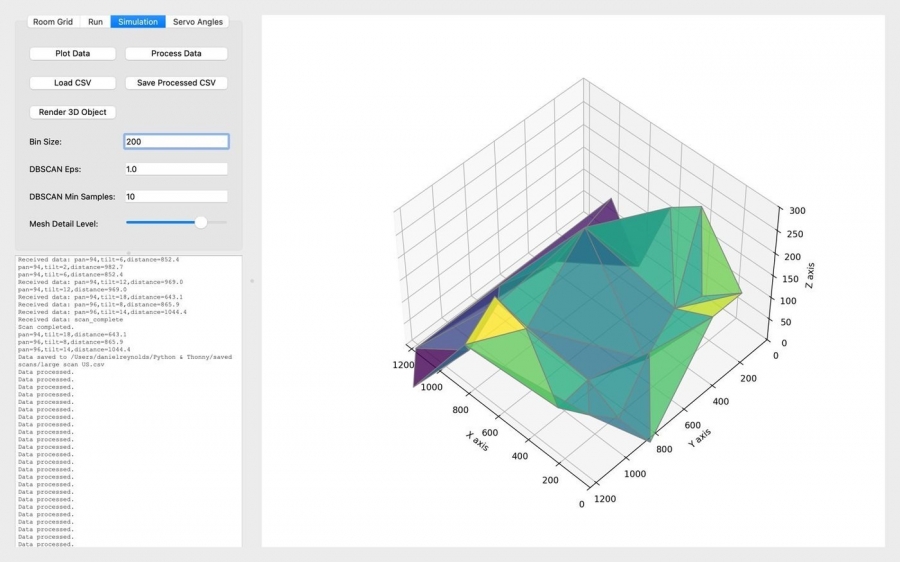
I designed and built a geared pan-tilt scanner, integrated ultrasonic and time-of-flight sensors, wrote MicroPython acquisition and BLE communication, and developed a Python/PyQt host application for control, capture and reconstruction.
Programmable scan sequence and wireless GATT transport
Spherical-to-Cartesian conversion and CSV data capture
Filtering, spatial binning, DBSCAN and mesh generation
Real-time visualisation shaped by the limitations of physical sensor data
Geared pan-tilt structure and sensing head.The completed physical system, not a simulation-only result.
Point-cloud output across repeated scans with configurable spatial and distance filtering.Processed surface output using configurable DBSCAN filtering and mesh generation.
For detailed machinery, structures, heavy-equipment and existing-product verification evidence, use the Mechanical & Product Engineering button above.
Mechanical design, machinery and product development
Let's discuss the engineering work.
I am interested in mechanical design and product engineering roles where practical experience, collaborative problem-solving and mechatronics knowledge can contribute to machinery and equipment development.